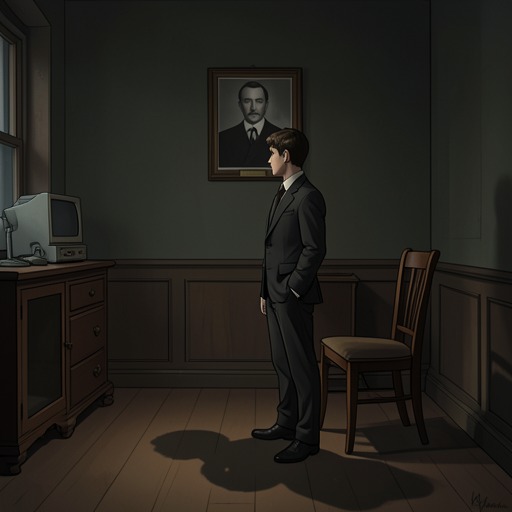
Finch Faces His Father’s Violence Again and Stops Him
All the Bright PlacesTheodore Finch’s confrontation with Ted Finch turns a return to the Finch family home into a decisive attempt to stop his father’s violence. Ted sends him across the kitchen, but Finch rises, catches his father’s wrist, and tells him the assault will not happen again. The scene’s central change is not that the family conflict is resolved: it is that Finch, who expects the attack to continue, refuses to meet it with the same fear and withdraws a boundary that Ted does not cross.
Arrival and Family Crisis
Finch sees Ted’s SUV before he sees his father. He nearly drives past the house and continues without knowing where he will go, but stops the car and walks inside. That hesitation makes the return a choice rather than an unconsidered arrival: he has imagined leaving, yet enters the home where he expects confrontation.
Ted charges out of the living room, with Linda Finch and another family member behind him. Linda is apologizing, though Finch cannot tell whether she is addressing him or Ted. Her explanation centers on a phone call at two in the morning, the possibility of an emergency, and Kate Finch not being home; she says she had no choice. The account gives the immediate circumstances of the family’s alarm without resolving precisely what the call concerned. Finch’s return therefore meets a household already responding to a crisis, but that concern does not prevent Ted from attacking him.
The Confrontation
Ted does not speak to Finch before sending him across the kitchen and into a door. Finch gets up and shakes off the encounter. When Ted raises his arm again, Finch laughs; the unexpected response stops Ted’s arm in midair. The scene marks a reversal in their established balance: Finch’s response surprises his father, who appears to see him as more unpredictable than he had thought.
Finch then makes the change explicit. He tells Ted that he could spend hours or days beating him, but that Finch no longer feels it in the same way. When Ted tries once more to strike him, Finch takes hold of his wrist and says that it will never happen again. The movement from being thrown across the kitchen to physically stopping the raised hand gives the boundary a concrete form. Finch does not claim that the threat has vanished; he acts to interrupt it in this encounter.
Ted drops his arm. Finch had not expected his words to work, and the account presents the sudden stop as a shift rather than a reconciliation. He turns to Linda, apologizes for worrying everyone, says that Violet is home and safe, and announces that he is going to his room. His concern for Violet is part of what he communicates while leaving the confrontation, but he does not describe the events that brought her home or elaborate on their relationship in this scene.
Aftermath at Home
Finch waits for Ted to follow him. Unlike his earlier defensive routine, he does not lock the bedroom door or push a dresser in front of it. He also waits for Linda to check on him, but nobody comes. He interprets the silence through the household’s pattern of non-engagement: because it is his home, people do not go out of their way to approach him. The contrast between the open door and his expectation of being left alone preserves the scene’s unresolved quality. Ted has stopped, but the family has not offered the reassurance Finch anticipates.
Finch writes to Violet Markey to apologize and to ask, in effect, whether she is safe from her parents’ reaction. He says that he wishes the events had unfolded differently but does not regret what came before. Violet replies that she is all right, asks whether Finch is all right and whether he saw Ted, and shares his lack of regret while wishing she could have got home on time. She also tells him that her parents do not want her seeing him anymore. The exchange carries the consequences of their situation beyond the Finch home: Finch has stopped his father in the moment, but Violet’s parents impose a new restriction on their relationship.
Significance
The encounter’s decisive action is small and specific: a hand reaches toward Finch, Finch catches the wrist, and Ted lowers his arm. The scene does not establish that the violence or the family’s silence has ended; its outcome is limited to this confrontation. That limit matters. Finch’s refusal to retreat changes what happens in the kitchen, while his open bedroom door and the absence of anyone checking on him show how little the household’s emotional conditions change afterward.
The episode also links protection and separation. Finch tells his family that Violet is safe, then reaches out to her privately; her response confirms that she is safe but reveals that her parents have forbidden further contact. The result is a paired consequence rather than a clean victory: Finch asserts a boundary against Ted, while the relationship with Violet acquires an outside barrier. The scene’s force comes from that uneven shift—one immediate act of violence is stopped, but neither family’s wider conflict is resolved.